
«Everything I wanted to say in music, I say in Platée», Jean Philip Rameau.
Analysis of the opera Platée by Jean-Philippe Rameau. Author, Jorge Auristondo Vilches.
– CULTURA – LIVE ON PATROL – LIVE WORLD TV GUIDE – US TORNADO WATCH –
Platée is the French opera that changed the history and format of all European music in the 18th century.
Platée is a comic story that laughs at political and religious power, its organization and institutions, and at the gross popular beliefs of mankind and the dullness of man.
Platée is a complete treatise on politics, psychology and sociology, although it was written and set for the people of its time, its criticism and analysis is totally current and permanent in time.
Platée is Humanity in the form of a nymphomaniac frog (of the Nymph family) who lives in a dark and foul-smelling puddle, but who makes ridiculous and supreme efforts – the supreme ridiculous – to sexually seduce Jupiter and win his love. Jupiter – God – has the form of a big-headed donkey who rules the world from a cloud and from which he observes and pretends to rule everything, but who does not understand anything because he is a donkey, and that is why the world is always upside down and feet up.

Technical information about the opera.
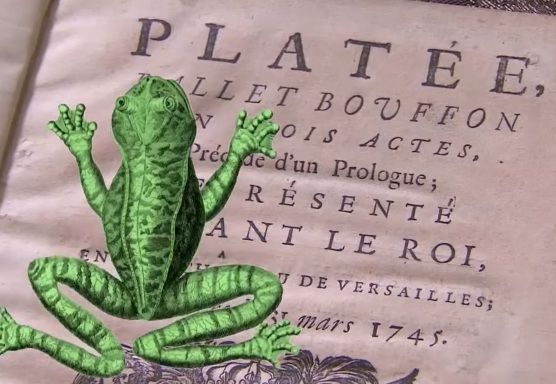
Platée has been classified by scholars as a «comic opera» in three acts with music by Jean-Philippe Rameau and libretto in French by Adrien-Joseph Le Valois d’Orville. It premiered on March 31, 1745 at the Grande Écurie in Versailles.
History and Plot
The opera is an adaptation for pre-revolutionary French society of a Greek myth related by the poet Pausanias in his «Description of Greece». The plot revolves around Platée, an ugly water nymph who believes that Jupiter, the king of the gods, is in love with her. Jupiter arranges a sham wedding with Platée to provoke his wife Juno’s jealousy and thus distract her from his infidelities. In the end, Juno discovers the deception and Platée, humiliated, returns to the reality of her swamp.
According to mythology, Platée was the daughter of Asopo, god of the river. Her story is mentioned in the work «Description of Greece» by Pausanias, a Greek geographer of the 2nd century AD.
In Greek mythology, Platée is known mainly for her relationship with Zeus (the Jovis Pater, Javen or Jupiter of the Roman mythology of the 8th century BC, the Jupiter Optimus Maximus, from which the Jews copied their god Yahweh in the 3rd century BC in Babylon).
In Rameau’s opera, this relationship becomes the center of the plot, where Platée is tricked into believing that Jupiter is in love with her, as part of a plan to cure the jealousy of Juno (Hera in Greek mythology).
Political and Religious Significances.
«Platée» was contracted to Rameau by the Queen of France herself and written for the wedding celebrations of Louis, the dauphin of France, to the Infanta Maria Teresa of Spain.
Rameau – who was a friend of Voltaire and a great encyclopedist and a revolutionary – chose a story about a fake wedding and a deceived bride as a satire of the inbred and political marriage alliances of the time. In addition, the opera reflects the tension between the gods of Olympus, symbolizing the intrigues, rivalries and social farces of the French court and the Catholic Church.
In the opera God is represented in Jupiter in the form of a donkey, which adopts various forms or manifestations to deceive and mock the frog Platée, representation of gullible humanity. In one of the scenes, Jupiter descends very awkwardly from a cloud, which adds a comic and theatrical element to the work.
In Platée, Rameau plays with the idea of transformation and disguise, common elements in Greek mythology and baroque operas. The representation of the gods in ridiculous or absurd forms is a way of satirizing and criticizing authority figures, both divine and human.
Rameau’s criticisms of the contemporary problems of eighteenth-century French society are fully valid today: the consolidation of an imperialist, global, Judaizing, and very minority oligarchy that seeks to take over and rule the world and nations through economic control, war, and religious superstition, issues that are fully in force.
Platée allows us to satirize the model of oligarchic society, its corrupt customs and its political and economic intrigues. By using gods and mythological creatures, Rameau and librettist Le Valois d’Orville were able to make humorous and critical comments on the excesses, vanity and rivalries of the nobility and aristocracy without directly attacking specific individuals.
Satirizing «Marriages of Convenience». The sham marriage between Jupiter and Platée is a parody of marriages arranged for political, religious and social reasons, which were and still are common in the inbred oligarchy. The work was commissioned for the wedding of the dauphin Louis, an event that had significant political implications, which adds a layer of irony to the opera.
Reflecting «Social Tensions». The depiction of Platée, an ugly and mocked nymph, satirizes superficiality and cruelty in society. The way Jupiter and the other gods treat Platée highlights the injustices and humiliations often faced by the less powerful or the less attractive at court.
Platée the frog teaches us that religious faith is vain and useless, because the gods demand adoration, submission and slavery, but from them we will not obtain any real and concrete good, we will only receive vain promises.
Psychoanalysis always makes use of mythology because it allows us to explore relevant themes in an understandable and acceptable way.
Opera Zoroaster and his contempt for oligarchy and tyranny that oppresses nations.
Rameau was an Enlightenment, Mason and revolutionary, anti-monarchist and anti-oligarchic, a friend of the people and of Voltaire.
In an aria of his opera «Zoroastre», Rameau talks about tyrants and tyranny. What is the aria that refers to tyrants and what is the work’s libretto, history, meanings about?
«Zoroastre», with libretto by Louis de Cahusac, premiered on December 5, 1749 at the Paris Opéra. The work is a «tragedy in music» that focuses on the figure of Zoroaster (Zarathustra), the prophet and founder of Chaldean Zoroastrianism.
The aria that mentions tyrants is «Lieux funestes». In this aria, Zoroaster laments oppression and tyranny, and expresses his desire to free his people from these evils, a thoroughly topical theme.
«Zoroastre» is set in ancient Persia or Chaldea and follows Zoroaster’s struggle against the forces of evil – political, economic and religious power – represented by the magician Abramane (the Jewish Abraham) and the followers and «functionaries» of the «system.» The plot includes elements of love, betrayal and redemption, with Zoroaster guiding man to the Light and Truth.
«Zoroastre» addresses several important issues:
1. Struggle between Good and Evil: Represented by Zoroaster and Abramane.
2. Freedom and Oppression: Zoroaster fights against tyranny to free his people.
3. Love and Sacrifice: The characters face personal dilemmas and sacrifices for the common good of society.
Both Rameau and his librettists and his music were highly criticized and even combated by the «officials» of the monarchy. His works were crushed by the press and the «official» critics, which led Rameau to premiere his works in small theaters and popular circuses, where his payment was often a plate of food and a bottle of good French wine.
Rameau himself tells us that often his only payment was a good meal and plenty of wine, but the beauty and deep harmony of his new music made him so famous and beloved that even the Empress Marie Antoinette herself became addicted to his art, and offered him a succulent contract to conduct the orchestra of the Palace of Versailles and compose for the king.
Jean-Philippe Rameau, the invincible revolutionary musician, did not live to see the historic events that unfolded in Paris in 1789 and marked the end of the monarchies and the birth of the Republic and the control of sovereignty by the people. Rameau died on September 12, 1764, 25 years earlier.
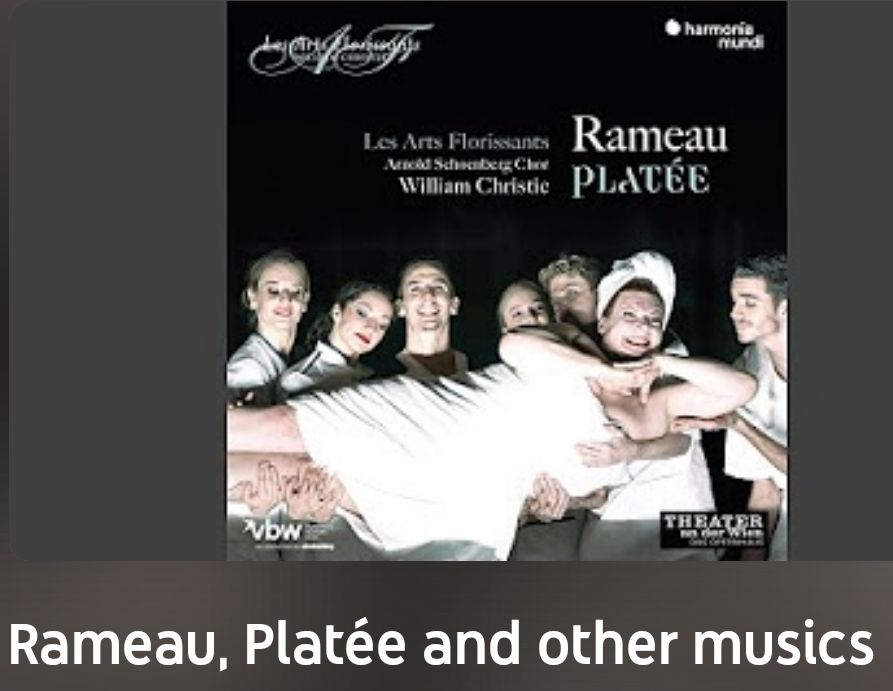
OPERA PLATÉE, DIR. MINKOWSKY, ACTO I

 Psicoanálisis de Geopolítica. Economía, Religión y Hechos Mundiales.