
The figure of the witch, both in the Middle Ages and in current English Wicca practice, offers a rich field of analysis from the perspective of psychoanalysis. Key interpretations of both figures in terms of symbolism, repression, archetypes and psychic processes are presented below.
Disquisitions on Magic and Psychoanalysis, the medieval witch and the modern witch. Author, Jorge Auristondo Vilches.
– CULTURA – LIVE ON PATROL – LIVE WORLD TV GUIDE – US TORNADO WATCH –
The Witch in the Middle Ages.
1. Projection of Internal Conflicts:
Sigmund Freud and Psychoanalysis describe how societies project their repressed fears and desires onto external figures. The medieval witch can be interpreted as a projection of internal conflicts and collective fears. The qualities attributed to witches, such as evil, lust and supernatural power, reflect repressed desires and anxieties within the very community to which she belongs.
2. The Shadow Archetype:
In another line of research Carl G. Jung introduced the concept of The Shadow, the unconscious aspect of the personality that contains repressed and unacknowledged impulses. The medieval witch embodies this archetype, representing the dark and forbidden. Witch persecutions can be seen as attempts by society to reject and eliminate these shadowy aspects projected onto marginalised individuals.
3. Women and Sexual Repression:
The figure of the witch is often associated with sexuality and female power. Freud spoke extensively about sexual repression and hysteria, which manifested itself in the demonisation of the independent and sexually free woman. Witch hunts can be interpreted as a way of controlling and repressing female sexuality, seen as a threat to the patriarchal and religious order.
4. Fear of Feminine Power:
The witch represents a challenge to patriarchal and religious power and authority. In the Middle Ages, women who were wise, healers or simply different were labelled as witches. From psychoanalysis, this reflects a deep fear of female power and a need to control and suppress it in order to maintain the dominant social structure.
The Witch in Contemporary English Wicca.
1. Reappropriation and Empowerment:
In contemporary British Wicca, the figure of the witch has been re-appropriated as a symbol of empowerment and connection with Nature. Carl G. Jung would speak of this process as a conscious integration of the repressed aspects of The Shadow, transforming the negative figure of the witch into a positive symbol of personal power and wisdom.
2. The Great Mother Archetype:
Wicca emphasises the veneration of the Goddess, an archetypal figure representing Nature, Fertility and Wisdom. Jung identified the archetype of the Great Mother as a powerful figure in the collective unconscious, and the contemporary witch can be seen as a manifestation of this archetype, celebrating the connection with the divine feminine and Nature.
3. Reconciliation with Nature:
Wiccan practice includes rituals that seek to harmonise with natural cycles and the energies of the earth. From a psychoanalytic perspective, this can be interpreted as a reconciliation with the instinctive and natural aspects of the human being that have been repressed by modern culture. The Wiccan witch, by embracing these elements, integrates parts of the unconscious related to the primitive and the instinctive.
4. Individuation and Autonomy:
Jung described the process of individuation as the path to realisation and wholeness, where the individual integrates all aspects of their psyche. The witch in contemporary Wicca symbolises this process of individuation, as she seeks the inner wisdom and spiritual connection that leads to greater autonomy and authenticity.
5. Resistance to the Dominant Culture:
Wicca, by challenging dominant religious and cultural norms, can be seen as a movement of resistance and affirmation of alternative values. Freud could interpret this as a rejection of cultural repression and an affirmation of repressed desires and values.
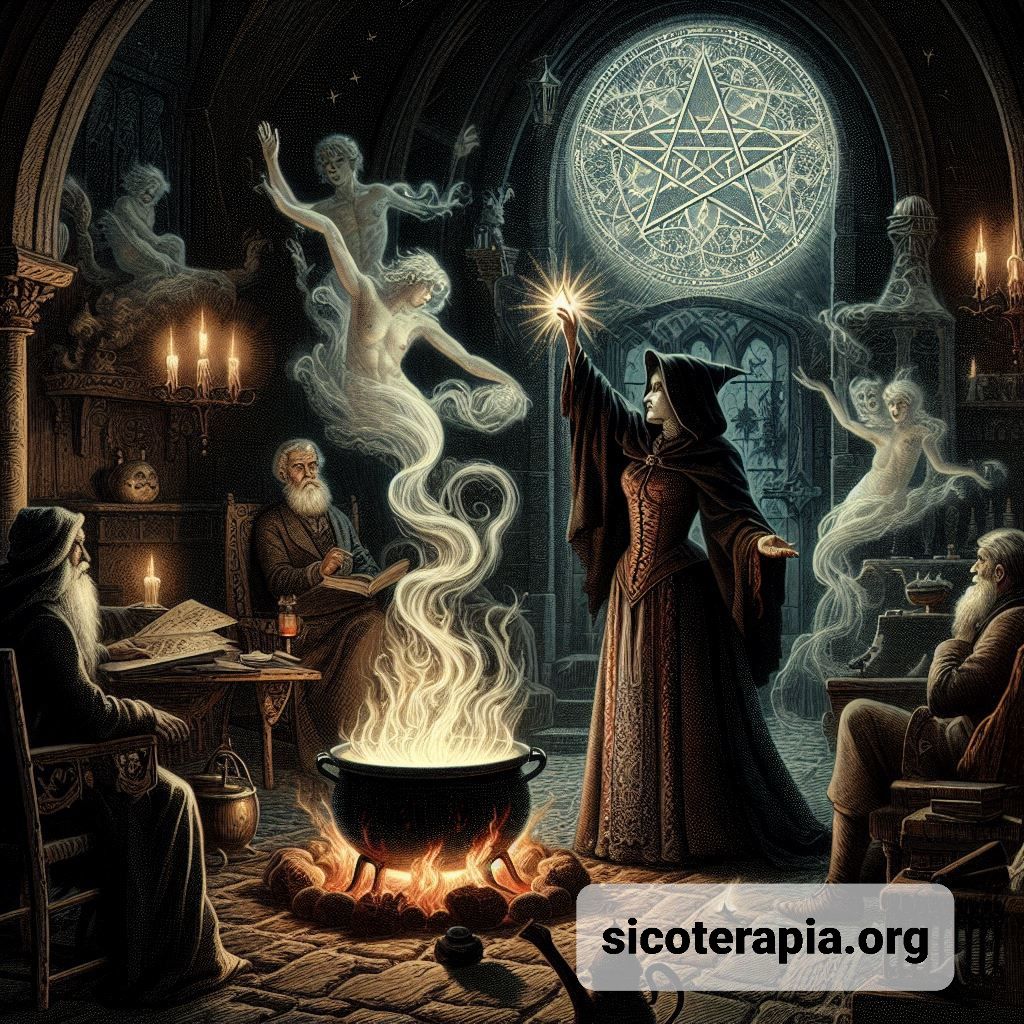
Comparison between the Two Epochs.
1. Fear and Projection versus Empowerment and Reconciliation:
In the Middle Ages, the witch was a feared and persecuted figure, representing the dark and repressed aspects of society. Today, the witch in British Wicca has become a symbol of empowerment and reconciliation with Nature and one’s own psyche.
2. Repression versus Integration:
Sexual and female power repression was a central motivation behind medieval witch-hunting. In contemporary Wicca, there is a conscious effort to integrate and celebrate these aspects, seeking balance and deeper spiritual connection.
Afterword.
In summary, the figure of the witch has evolved from a symbol of fear and repression in the Middle Ages to one of empowerment and spiritual connection in contemporary Wicca. From psychoanalysis, this evolution reflects changes in the way society and individuals deal with repressed aspects of the psyche, as well as a search for integration and personal fulfilment.

 Psicoanálisis de Geopolítica. Economía, Religión y Hechos Mundiales.